
Noticias
Paco Yáñez | ‘I have always been fascinated by the history of music in its broadest sense’ Unsuk Chin
26/10/2026
An interview by Paco Yáñez for El Compositor Habla What does it mean to find one's own artistic voice, and how can it remain free from conventions and expectations? In this conversation with Paco Yáñez, Unsuk Chin champions artistic independence, curiosity, and a constant willingness to question established ideas as driving forces behind the creative process. An insightful perspective on the music of our time and the challenges faced by those who dare to explore new paths.
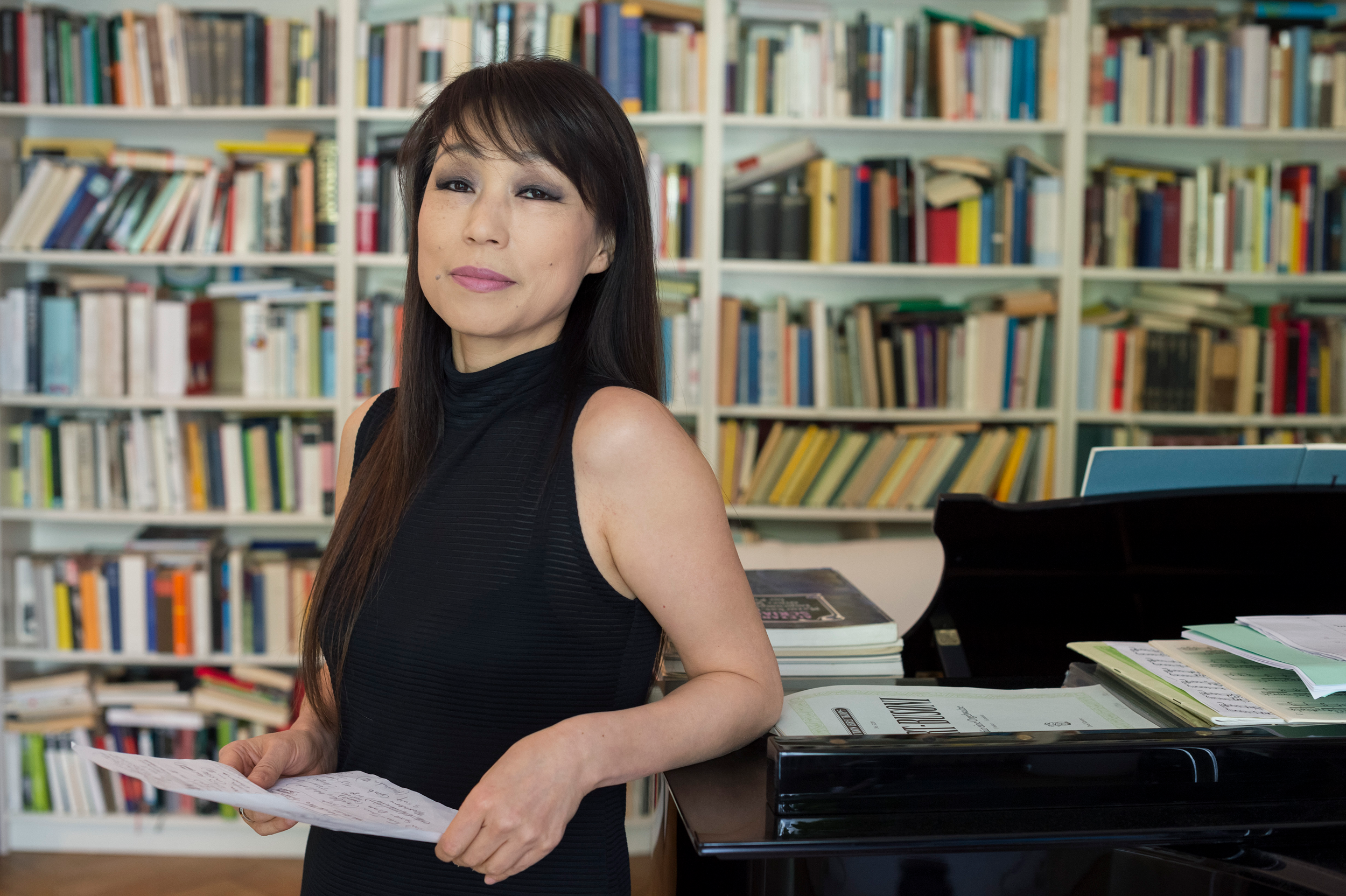
On 18 March, the BBVA Foundation awarded its 18th Frontiers of Knowledge Prize in the Music and Opera category to the South Korean composer Unsuk Chin (Seoul, 1961), thus adding to the list of awards recognising the career of one of the world’s most important composers, as well as serving as an active artistic link between Asia and Europe.
After her studies in the Seoul National University with Sukhi Kang, Unsuk Chin completed her higher education in Hamburg under one of the most influential composers in history, György Ligeti, and subsequently developed a career in which dreams, literature and the sciences are among the influences on her scores – works of immense artistic personality, always seeking to transcend the boundaries of convention, ranging from chamber music to opera, including her highly rhythmic, colourful and timbrally fascinating orchestral scores.
We discussed all of this in this interview with Unsuk Chin.
1. Paco Yáñez: You have just been awarded the 18th BBVA Foundation Frontiers of Knowledge Prize, one of the world’s most prestigious awards in the field of music. What does this mean to you?
Unsuk Chin: I feel immensely grateful and honoured, especially when I look at the distinguished list of previous recipients. What makes this award particularly meaningful to me is that it brings together people from such different fields of knowledge, including outstanding scientists whose discoveries have transformed our understanding of the world. It is wonderful to be part of such a remarkable community.
Many of the previous laureates are also cosmopolitans who have contributed to building bridges between different cultures, disciplines and traditions. This is something I find particularly inspiring.
An award of this kind is therefore also an acknowledgement of the importance of intellectual independence and of a culture in which curiosity, imagination and quality can flourish beyond national, cultural or aesthetic boundaries.
2. P.Y.: Another reason why Unsuk Chin is in the news is your artist-in-residence programme at the Konzerthaus Berlin. How did this residency come about, and what projects do you have planned there for the season 2026-2027?
Unsuk Chin: Joana Mallwitz and Tobias Rempe [Artistic Director of the Konzerthaus Berlin] approached me with the idea, and I was immediately excited by what they were developing at the Konzerthaus. I am hugely looking forward to working with Joana.
I am delighted to be part of a season that includes such a broad range of projects, from symphonic concerts to chamber music and more conversational and interdisciplinary formats. There is also the opportunity to work alongside the wonderful soprano Vera-Lotte Boecker, who is Artist in Residence this season at the Konzerthaus Berlin.
One particular highlight for me is the German premiere of Le Chant des Enfants des Étoiles (2015-2016), a large-scale work for children’s choir, mixed choir, organ and orchestra. Such opportunities are quite rare, given the forces required.
I am particularly thrilled that contemporary music at the Konzerthaus Berlin is approached as a natural and integral part of musical life. I also find the Konzerthaus’ imaginative ways of communicating music and reaching new audiences very exciting. It is particularly meaningful to be involved in such an initiative in Berlin, the city that has been my home for almost four decades.
3. P.Y.: The current principal conductor of the Konzerthausorchester is Joana Mallwitz. For El Compositor Habla, highlighting the work of female composers and female conductors of our time is of fundamental importance. How do you view the still rare occurrence of a female composer and a female principal conductor joining together an artistic residency? Have you noticed any particular changes throughout your career regarding the presence of women in the world of classical music?
Unsuk Chin: There have undoubtedly been changes over the past decades, and the visibility of women composers and women conductors has increased considerably.
The problem —regardless of gender— is overcoming established expectations concerning repertoire, careers and artistic identities, and these can be difficult to change.
Personally, I have never wanted to define myself primarily as a female composer. I have always tried to concentrate on my work rather than on the prejudices that might exist, since constantly thinking about them would have been stifling for my creativity.
Ideally, we should reach a point where the collaboration between a female composer and a female conductor is no longer considered exceptional. What should matter is artistic quality, imagination and the willingness to explore something new.
«The visibility of women composers and women conductors has increased considerably»
4. P.Y.: Which works by Unsuk Chin will we be able to hear at the Konzerthaus Berlin over the coming months?
Unsuk Chin: The season offers quite a broad panorama of my music.
It began [in September, conducted by Jonathan Nott] with Subito con forza (2020), my orchestral homage to Ludwig van Beethoven, and [in October, conducted by Oscar Jockel, with Vera-Lotte Boecker as soprano] a scene [the Aria Die Sterne auf der Himmelsschale] from my opera Die dunkle Seite des Mondes (2024-2025).
In December, there will be a conversation-concert featuring three of my Piano Études (1995-2003) and Gran Cadenza (2018) for two violins. An interdisciplinary portrait evening, Unsuk Chins Universum, follows in January.
In March, my Cello Concerto (2006-2008, rev. 2013) will be performed, a work that has had a particularly rich performance history since its premiere in 2009.
April brings the German premiere of Le Chant des Enfants des Étoiles, the large-scale work I mentioned before for children's choir, mixed choir, organ and orchestra, inspired by astronomy and cosmology and drawing on poetry from several centuries.
Finally, in July, there will be a performance of Alaraph (2022), another orchestral work inspired by cosmic phenomena.
It is a wonderful opportunity to present very different aspects of my work within a single season.
5. P.Y.: This artist-in-residence programme will require you to work in depth with the Konzerthausorchester. How does Unsuk Chin normally approach rehearsals of her works with an ensemble or an orchestra?
Unsuk Chin: For me, the starting point is always trust. I believe that musicians and conductors need the freedom to develop their own relationship with a score. I generally prefer to let them work first, to listen carefully, and then to offer suggestions or clarification where necessary. Of course, I am always happy to answer questions.
I have been extraordinarily fortunate to work with numerous outstanding conductors and performers. The technical level of orchestras today is also quite astonishing, particularly in contemporary repertoire. Works that might once have seemed almost impossibly demanding can now be approached with remarkable precision and imagination.
This is one of the great pleasures of being a composer: hearing how different musicians bring something individual to the same score.
«‘I believe that musicians and conductors need the freedom to develop their own relationship with a score»
6. P.Y.: Are there elements in your music that stem from your Korean heritage – or from whatever Asian influence may remain in your scores – which European performers find more difficult to understand?
Unsuk Chin: No, I have not really experienced this. I believe that music is universal and can communicate across cultural boundaries.
There are certainly elements of Korean musical traditions in some of my works. In Alaraph, for instance, certain aspects of Korean court ritual music and folk music play a role. But these exist alongside numerous other references, from different cultures, historical periods and musical traditions.
I have always been fascinated by the history of music in its broadest sense, including the relationships between seemingly distant musical worlds.
For me, these influences are not separate national ingredients. They become part of a complex musical language, in which different layers interact and are transformed into something new.
7. P.Y.: For European music lovers, the best-known figures in Korean music are yourself and Isang Yun. Which other established or emerging composers of contemporary Korean music do you think we in Europe should be familiar with?
Unsuk Chin: I am very happy to see that there are now so many interesting and individual voices among Korean composers. Some are studying, living and working in Europe or elsewhere internationally, while others are based primarily in Korea.
I would hesitate to single out just a few names, as this might give the impression of favouring certain composers over others in what has become a remarkably diverse musical scene.
There has clearly been an enormous diversification over the past decades. Contemporary music is performed much more frequently in Korea than it used to be, and there is an increasing openness towards unfamiliar music.
This also has much to do with the extraordinary surge of Korean performers. Many have a much broader repertoire today, encompassing not only the established classics but also contemporary works and music from very different traditions.
The result is a much more varied musical landscape, with greater curiosity, more possibilities for composers and a growing expectation among audiences that they may encounter something unfamiliar.
«Contemporary music is performed much more frequently in Korea than it used to be, and there is an increasing openness towards unfamiliar music»
8. P.Y.: Which aspects of your training in Korea continue to shape your personality as a composer?
Unsuk Chin: That was more than forty years ago, so it is difficult for me to separate particular influences retrospectively.
Of course, meeting Sukhi Kang was extremely important. He possessed an extraordinary knowledge of contemporary music and opened up a world that would otherwise have been largely inaccessible to me at the time. That was an enormously liberating experience.
Certain layers of my early experiences undoubtedly remain important, but they now coexist with many other layers accumulated over the decades.
I have lived in Germany since 1985, and in Berlin since 1988, but I would not describe my music as German-influenced simply because of that. Nor do I think that the influences of my Korean years can be neatly separated from everything I have encountered since.
For me, composing has always involved absorbing, questioning and transforming very different experiences into an individual musical language.
9. P.Y.: In 1985, you arrived in Hamburg to study at the Hochschule für Musik und Theater with György Ligeti. What impression did he make on you, and what do you remember about the brilliant Hungarian maestro?
Unsuk Chin: What impressed me enormously was that Ligeti was going through a period of profound artistic reorientation. He was distancing himself from the established avant-garde and exploring musical worlds far beyond the conventions of European modernism.
He was fascinated by the complex rhythmic structures of sub-Saharan African music, by Conlon Nancarrow, by medieval Ars subtilior, and by musical worlds far removed from the established European avant-garde.
What was extraordinary was his intellectual openness and his courage to question and transform his own artistic language at that stage of his career.
He was extremely self-critical, but equally critical of almost everything around him. Nothing could simply be accepted as a given. He was constantly questioning assumptions, conventions and established ways of thinking.
Perhaps the most important lesson was that creating something genuinely new could not mean following the dogmas of a collective movement. It required independence, curiosity and the courage to question even one's own previous achievements.
«For me, composing has always involved absorbing, questioning and transforming very different experiences into an individual musical language»
10. P.Y.: In which of your works do you think one can hear that influence from Ligeti?
Unsuk Chin: That is really for others to judge.
I studied with Ligeti between 1985 and 1988, and during much of that period I hardly composed at all. It was a time of questioning and reconsidering my musical language.
Of course, influences are inevitable. They come and go throughout one’s life, and it would be absurd to pretend otherwise. But the important thing is how they are absorbed and transformed.
One has to assimilate influences consciously, rather than imitate them involuntarily. Otherwise, one risks reproducing somebody else’s language instead of developing one’s own.
What matters to me is not whether a particular passage might remind someone of Ligeti or something else, but whether all these different experiences have ultimately become part of an independent musical language.
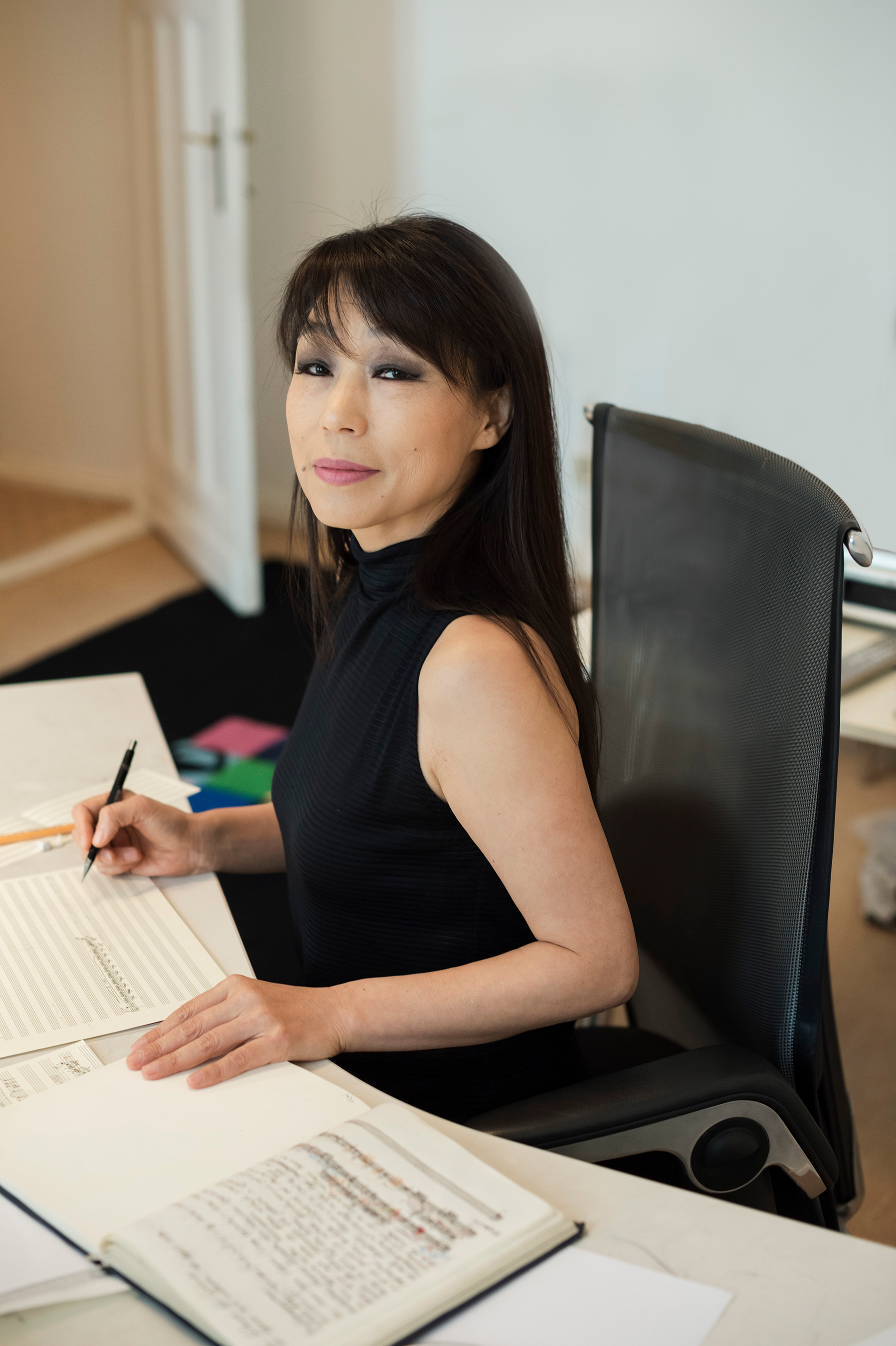 11. P.Y.: Following that period of learning and reflection with György Ligeti in Hamburg, in which piece did Unsuk Chin feel she had finally found her own personal voice, her own independent musical language?
Unsuk Chin: The earliest work I have kept in my catalogue is Die Troerinnen (1996, rev. 1990), for three female soloists, women’s chorus and orchestra. I wrote it while studying with Ligeti in Hamburg. It already marked a stark departure from the post-serial works with which I had won international prizes before coming to Hamburg, and which he urged me to move beyond. After Die Troerinnen, however, I went through a period in which I could not compose.
It was only after leaving Hamburg and beginning to work in an electronic music studio in Berlin that I overcame my own creative block. Working with electroacoustic music was a form of fundamental research for me: it greatly expanded and enriched my musical thinking, even though I returned to the medium only occasionally in later years.
Die Troerinnen is very different from much of my later output, but I still accept it as part of my catalogue. More generally, I am sceptical about the notion of a fixed “style”. With each new work, I try to set myself new challenges.
Die Troerinnen es muy diferente de gran parte de mi producción posterior, pero sigo aceptándola como parte de mi catálogo. En términos más generales, soy escéptica respecto a la noción de un ‘estilo’ fijo, pues con cada nueva obra intento plantearme nuevos retos.
12. P.Y.: For anyone wishing to explore your musical catalogue, which pieces would you recommend as essential for gaining a better understanding of Unsuk Chin, or as those in which your musical language underwent a significant change?
Unsuk Chin: I do not particularly like looking back. My attention is usually on the next piece and the challenges it presents, although I do of course revise earlier works from time to time. I stand by the works I have written except those that I have withdrawn from the catalogue, but I want to move ahead: if I ever consider that I have now written the piece that is perfect, I should stop composing because it means I have reached a dead end.
Of course, that can create challenges, as the music business often expects a certain repetition. Igor Stravinsky was asked decades later why he would not write another work like The Firebird. Imagine asking that of the creator of masterpieces such as, for instance, his Agon or his Violin Concerto. But this is a big problem in the music business: famous composers are famous only for certain works. As for Claude Debussy, works such as La Mer or the first book of his Préludes are famous and constantly performed, but what about Jeux or En blanc et noir?
«Working with electroacoustic music was a form of fundamental research for me: it greatly expanded and enriched my musical thinking»
So, works can have unexpected histories. To take two extremes from my output: on the one hand, Subito con forza, a short orchestral vignette combining parody with homage to Beethoven, a piece rather atypical of my oeuvre. It is by far my most performed piece, no doubt due to the mechanisms of the concert business that favour short contemporary openers that can be quickly absorbed.
My Piano Concerto of 1996–97, on the other hand, was and remains an important work for me, but remained largely neglected for two decades after its premiere. Some orchestras that had planned to perform it even dropped it from their programmes because it was considered too difficult. Then Sunwook Kim recorded it for Deutsche Grammophon [with the Seoul Philharmonic Orchestra, conducted by Myung-Whun Chung] and gave it a new lease of life. Other pianists, including Francesco Piemontesi and Bertrand Chamayou, have since taken it into their repertoire, and it is now performed with a certain regularity despite its demands on the soloists and orchestra. Reception cannot be foreseen, and there are surprises along the way.
13. P.Y.: Your catalogue includes two major operas, Alice in Wonderland (2004–2007) and Die dunkle Seite des Mondes. Would you like to compose more operas? What artistic and musical challenges do you set yourself when composing operas?
Unsuk Chin: Opera continues to fascinate me, particularly its “impure” nature. It brings together music, theatre, literature and the visual arts, and composing an opera requires a willingness to relinquish stylistic purity in my opinion, also to accept its inherent contradictions. It is quite obvious: some of the greatest operas draw their force from elemental emotions and situations: love, betrayal, violence, resignation. In my own work, I like to introduce some resistance into that emotional machinery, a certain degree of alienation, to explore subjects that do not yield too readily to familiar dramatic stories. Labyrinthine forms of narration can open up particularly interesting possibilities for contemporary music, but it is also a question of how to balance the classic operatic effects. What interests me is opera’s capacity to move us deeply while also provoking reflection. Its combination of different arts can seem surreal or excessive, yet it can move and stir by bringing apparently irreconcilable things together.
Photographs of Unsuk Chin by Priska Ketterer and Bonsook Koo
© Paco Yáñez, October 2026


